Desizing Floor Checks: What the Iodine Test Tells a Pretreatment Team
In a cotton mill, the iodine test is not a laboratory trophy. It is a shift-floor check that helps a pretreatment team see whether starch size is still holding in the fabric before the lot moves into scouring, bleaching, dyeing, or printing.
For mills running tight shade commitments, the value is practical: catch uneven desizing early, reduce avoidable reprocessing, and keep downstream wet-out consistent enough for the next process to do its job.
Enzymebridge works as a textile desizing enzyme supplier for fabric mills that need desizing performance aligned with real production windows: fabric construction, liquor ratio, pH control, temperature profile, dwell time, and washer load.
What the iodine test is really telling you
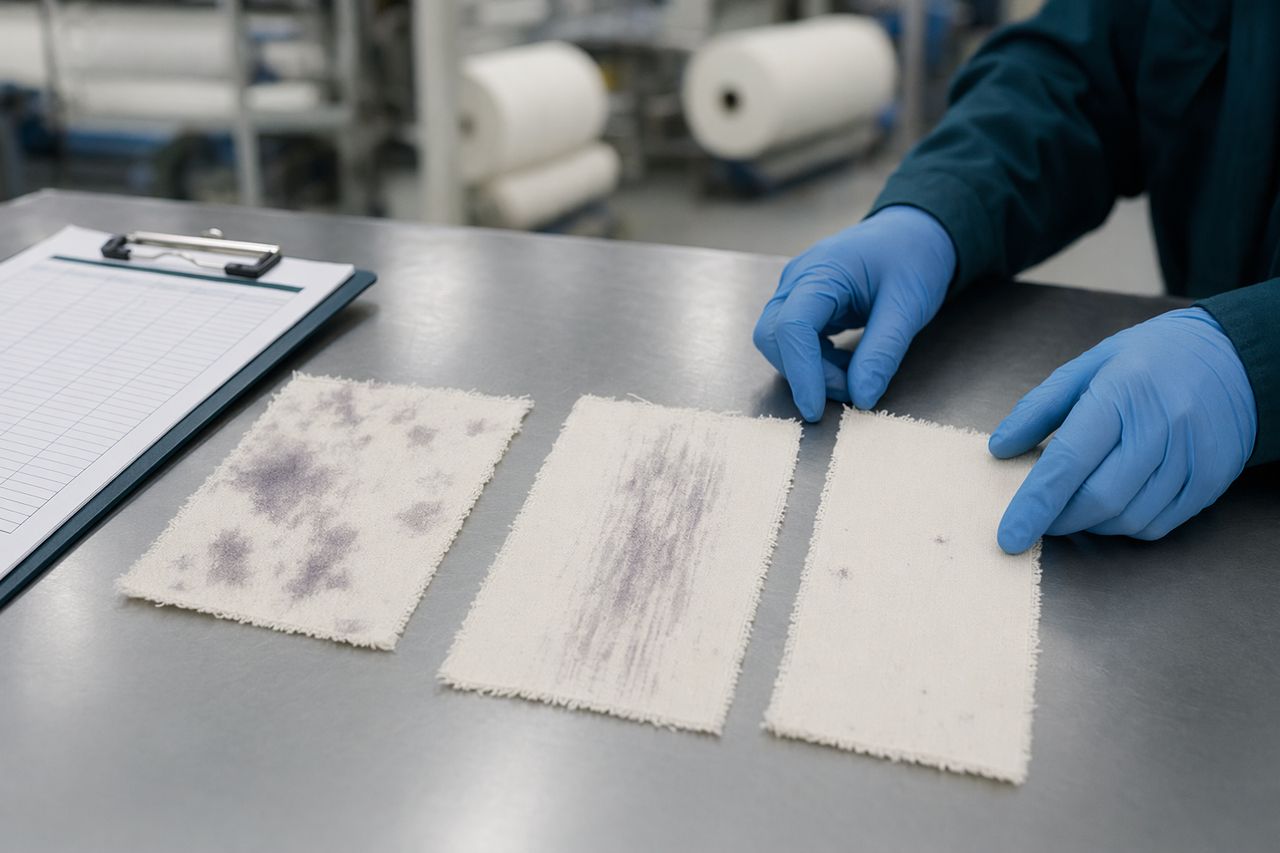
The iodine check gives a visual indication of residual starch on cotton fabric. When a greige fabric has been sized with starch-based materials, iodine reacts with remaining starch and produces a darker stain. A lighter response generally indicates that starch has been removed more completely.
For a pretreatment manager, the important question is not simply, “Did it pass?” The useful question is:
Where is starch still present, and what does that pattern say about the process?
A good floor check can point toward:
- Incomplete enzyme contact through the fabric body
- Uneven wet-out across the width
- Side-center-side variation
- Roll-to-roll inconsistency
- Overloaded washer sections
- Temperature or pH drift outside the working window
- Insufficient fabric dwell or excessive line speed
- Starch concentration variation from weaving lots
The iodine test does not replace process control. It helps the team decide where to look first.
Why starch left behind creates downstream risk
Residual starch is not just a desizing issue. It can follow the fabric into the next operation and show up as operational drag.
Common mill symptoms linked to poor desizing
- Patchy absorbency during scouring or bleaching
- Inconsistent wet-out at the padder
- Harsh or boardy fabric handle after pretreatment
- Shade variation caused by uneven dye liquor access
- Localized print defects or specking
- Higher chemical correction demand downstream
- Rewash or reprocess decisions made under delivery pressure
A clean iodine check does not guarantee dyeing success by itself, but a poor iodine response is a warning that the fabric is not yet in a reliable condition for the next stage.
Reading the pattern, not just the color
The strongest value comes from pattern recognition. A single dark spot tells you less than a mapped comparison across the fabric.
| Iodine check observation | Likely process signal | What to review first |
|---|---|---|
| Darker center than selvedges | Uneven liquor penetration or fabric compaction | Guide setting, fabric rope/open-width control, washer loading |
| Darker selvedges than center | Edge wet-out or tension issue | Entry wetting, fabric tracking, spray coverage |
| Alternating dark and light bands | Intermittent contact or dwell variation | Line speed stability, padding consistency, batching uniformity |
| Dark streaks in warp direction | Size concentration or fabric construction effect | Weaving lot notes, yarn count, size add-on history |
| Whole sample remains dark | Enzyme process not reaching starch load | Temperature window, pH window, enzyme dosage strategy, dwell time |
| Random dark specks | Localized contamination or trapped size | Washing efficiency, crease points, fabric opening before treatment |
This is where operator notes matter. The iodine result should be logged beside lot ID, fabric style, machine, shift, recipe version, bath condition, and any abnormal stop-start events.
A practical floor-check rhythm
The best programs keep the check simple enough to be used consistently, but disciplined enough to support decisions.
Build a repeatable sample map
Instead of taking one convenient swatch, sample across the width and at practical intervals along the lot. Side-center-side checks help reveal distribution issues that a single cut piece can hide.
Compare against the same fabric style
A poplin, twill, denim, sheeting, and voile do not always release size the same way. Compare results against the fabric construction and size history when available.
Keep the check close to the machine
The value of the iodine test is speed. If a result comes back while the lot is still in process or before the next major operation, the team has options: adjust, hold, rewash selectively, or isolate the risk.
Record visual evidence
A phone image under consistent lighting, attached to the lot record, can support shift handover and audit documentation. It also helps technical teams spot recurring patterns.
What the iodine test does not tell you
The iodine check is useful, but it has limits.
It does not fully measure:
- Overall absorbency
- Wax removal
- Pectin removal
- Seed-coat fragment control
- Bleach readiness
- Dye fixation behavior
- Final fabric handle
A weak iodine response can support confidence that starch removal is under control, but downstream readiness still depends on the full pretreatment sequence.
When a poor result should trigger enzyme review
If iodine failures are occasional and tied to a known event, the fix may be operational. If the pattern repeats across styles, shifts, or machines, the desizing chemistry may not be matched to the real mill window.
Enzymebridge typically reviews:
- Cotton construction and weave density
- Starch type and size blend where known
- Rope or open-width process route
- Liquor ratio behavior and wet-out limitations
- Working pH and temperature range on the floor
- Dwell time available at normal production speed
- Washer configuration and rinse efficiency
- Reprocessing history and dyehouse complaints
The goal is not to overcomplicate the recipe. The goal is a desizing enzyme program that performs inside the process window the mill actually runs.
Using iodine checks to reduce reprocessing
Reprocessing often begins as uncertainty. A pretreatment team sees a questionable fabric condition and has to decide whether to release, rewash, or hold for review. Iodine checks reduce that uncertainty when they are tied to clear action rules.
A practical decision structure may include:
- Release when the visual response is clean and consistent across the mapped sample points.
- Hold and review when the response is uneven but localized.
- Adjust process when the same pattern repeats across sequential checks.
- Escalate chemistry review when acceptable settings still leave residual starch.
This turns the iodine test from a yes-or-no stain into a control point for production reliability.
How Enzymebridge supports desizing control
Enzymebridge supplies enzyme solutions for cotton textile mills that need predictable starch removal without creating unnecessary disruption to existing pretreatment routes.
We support mills with:
- Desizing enzyme selection for actual temperature and pH windows
- Guidance for wet-out consistency and liquor contact
- Troubleshooting support for side-center-side variation
- Recommendations for reducing repeat desize or rewash events
- Documentation support for technical review and customer audits
- Process-oriented communication for pretreatment, dyehouse, and quality teams
When starch removal is controlled, the next departments receive fabric with fewer surprises. That is the real purpose of the iodine test.
Request a quote
If your mill is seeing residual starch, uneven iodine results, wet-out variation, or repeat desizing corrections, share your fabric route and operating window with Enzymebridge.
Request a quote through the on-site form and our technical team will respond with a mill-ready desizing enzyme recommendation.